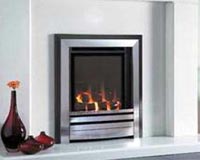
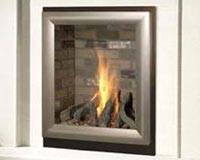
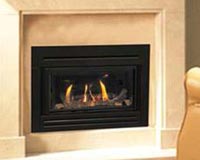
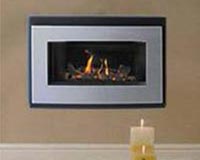
Insert gas fires fitted into existing fireplace openings across the Costa del Sol. Butane, propane and piped natural gas, registered gas installer, three-year parts and labour warranty.
Fireplace insertsReal-flame effectBoletin de gasThree-year warranty
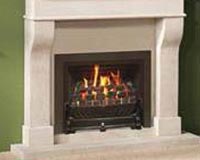
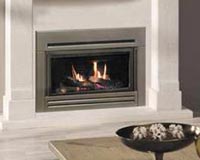
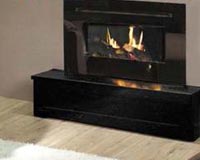
Many Costa del Sol villas were built with a fireplace in the lounge that the owners never use. The chimney works but the open fire pulls more heat out of the room than it puts in, and most British and European owners do not want the routine of clearing ash on a Sunday morning. An insert gas fire slides into the existing fireplace opening, runs on butane, propane or piped natural gas, and gives a real-flame display behind a glass front with adjustable output. The hearth and surround stay as they were. We fit insert gas fires across the Costa del Sol from Nerja to Gibraltar.
How an insert differs from a stove or a wood burner
An insert sits flush in an existing fireplace opening, with the surround and hearth left in place. A free-standing gas stove sits out in the room with its own flue running up the wall. A wood burner is the same shape as a stove but burns logs and needs ash and chimney maintenance. Insert gas fires give the cleanest finish where there is already a fireplace to work with. They also retain whatever feature surround the property has (cantilevered marble, tile work, a rustic stone hearth) without ripping out the original detail.
Slides into an existing fireplace opening
Real flame behind a sealed glass front
Heat output adjustable from low ambience to full room heat
No ash, no chimney sweeping, no log storage
Sizing the insert to the room and the opening
Inserts come in standard widths from 600 mm to 1,200 mm to suit common fireplace openings. The output ranges from 4 kW for a small lounge to 9 kW for a larger open-plan room. Sizing too small leaves the room never quite warm. Sizing too large pushes too much heat at low setting and the controls run on minimum all evening. We measure the existing opening on the survey and pick a model that fills the opening neatly without major masonry work.
Flue work and the existing chimney
Most insert installs use the existing chimney, lined with a twin-wall flexible liner that runs from the appliance up through the chimney to the chimney pot. The liner is sized to the appliance output and meets the manufacturer specification for the gas appliance. Where the existing chimney is in poor condition or where there is no chimney, a balanced-flue (room-sealed) insert is an option, with a horizontal vent through the wall behind the fireplace.
Boletin de gas and certification
Insert gas fires are gas appliances and need a boletin de gas from a registered gas installer (instalador autorizado de gas). The boletin certifies the appliance, the gas supply and the room ventilation as compliant with RITE. The owner needs the paperwork for insurance and resale. An annual flue and combustion check on the appliance keeps the certification in date. Our engineers are registered gas installers and the boletin goes on file the day the work is signed off.
Survey, quote and installation
From first call to working system
Step 1
Site survey
An engineer visits the property to measure the existing fireplace opening, check the chimney route, identify the gas supply and recommend the right insert size. Survey appointments are free.
Step 2
Quote and product pick
We send a written quote with the recommended insert, the flue liner spec, the gas connection, the boletin fee and the labour figure.
Step 3
Installation
Most insert installs run as a one to two day job. The flue lining and the gas pipework are the limiting factors on the schedule. We protect the surround, the hearth and the floor through the install.
Step 4
Commissioning and boletin
We commission the appliance, run a flue draught test and a combustion analysis, register the boletin de gas and walk through the controls. Three-year parts and labour warranty starts that day.
Why EnviroCare
Why local experience matters
Trading since 1996
Close to thirty years installing and servicing gas appliances on the Costa del Sol for British and European homeowners across the coast.
Registered gas installers
Insert gas fires need certification by a registered gas installer (instalador autorizado de gas). Our team handles the boletin as part of the install.
Multilingual office
English, Spanish and Dutch across the office and field staff. Quotes, invoices and the boletin paperwork issued in your preferred language.
Three-year parts and labour
Every new install carries a three-year EnviroCare warranty on parts and labour, on top of the manufacturer warranty on the appliance.
Models
Models and ranges we install
Fenix Lenos
Output: 4 kW
Size: Front 656 × 504 mm · Back 511 × 452 × 268 mm
Fuel: Natural gas, propane
Colours: Gold, silver, black
Marcello
Output: 4.2 kW
Size: Inset front 1,164 × 739 mm · Inset back 747 × 612 × 100 mm
Fuel: Natural gas, propane
Colours: Black on black, black on silver
Also available wall-hung at 1,110 × 685 mm front, 747 × 612 × 145 mm back.
Alpena
Output: 4.3 kW
Size: Front 500 × 600 mm · Back 405 × 565 × 180 mm
Fuel: Natural gas, propane
Colours: Gold, silver
Alpena Frontier
Output: 4.3 kW
Size: 3-sided front 540 × 620 mm · 4-sided front 540 × 695 mm · Back 405 × 565 × 180 mm
Fuel: Natural gas, propane
Colours: Black on silver
Meridian
Output: 4.5 kW
Size: Front 620 × 760 mm · Back 550 × 715 × 230 mm
Fuel: Natural gas
Colours: Black on silver, champagne
Kalido 73
Output: 5 kW
Size: Front 730 × 525 mm · Glass 525 × 235 mm · Back 630-460 × 450 × 360 mm
Fuel: Natural gas, propane
Colours: Black, anthracite
Smart 74
Output: 5 kW
Size: Front 740 × 505 mm · Glass 525 × 235 mm · Back 630-460 × 450 × 360 mm
Fuel: Natural gas, propane
Colours: Black on grey, black on black
Sevilla
Output: 5.5 kW
Size: Front 656 × 504 mm · Back 555 × 458 × 210 mm
Fuel: Natural gas, propane
Colours: Gold, silver, black
Smart 78
Output: 7 kW
Size: Front 780 × 545 mm · Glass 565 × 275 mm · Back 670-480 × 492 × 410 mm
Fuel: Natural gas, propane
Colours: Black on grey, black on black
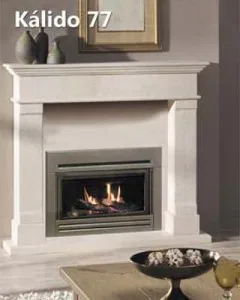
Kalido 77
Output: 7 kW
Size: Front 770 × 558 mm · Glass 565 × 275 mm · Back 670-480 × 492 × 410 mm
Fuel: Natural gas, propane
Colours: Black, anthracite
Kalido Kristal
Output: 7 kW
Size: Front 800 × 550 mm · Glass 535 × 250 mm · Back 670-480 × 492 × 365 mm
Most existing fireplaces will take an insert with minor masonry work to square the opening, but very small or non-standard openings sometimes need a custom-built or pre-fabricated frame. We measure the opening on the survey and confirm what is feasible before quoting.
Does the existing chimney need work before fitting an insert?
Almost always. Older chimneys are often unlined and can leak combustion gases through cracks in the brickwork. Lining the chimney with a twin-wall flexible liner is part of every insert install, sized to the appliance and meeting the manufacturer spec. Where the chimney is in poor condition, the liner replaces the old flue path entirely.
Will an insert heat the whole lounge?
Yes for most rooms. A 6 to 7 kW insert in a typical 25 to 35 square metre lounge holds the room at 21 to 23 degrees on a Costa del Sol winter evening. Larger open-plan rooms or rooms with patio glazing usually need 8 to 9 kW or a paired solution with a wall-mounted heat-pump split for daytime use.
How much does an insert cost to run?
An insert running for two to three hours an evening through December and January costs roughly 60 to 100 euro a month on butane, depending on size. Piped natural gas works out cheaper per kWh than bottled butane. Heat-pump air conditioning on heating mode is cheaper still per kWh, but inserts win on the visual and ambience side that owners often value most.
Can the insert run from butane bottles?
Yes. Most Costa del Sol installs run on butane, with the bottle set in a ventilated cupboard or external locker and piped to the appliance. A 6 to 7 kW insert uses one bottle every three to four weeks of regular evening use through winter.
How do I get a quote?
Send a WhatsApp to +34 670 409 759 with a photo of the existing fireplace and the dimensions, or use the contact form for a callback. We book a free survey, measure the opening and quote within a few days.
Need help with insert gas fires?
Tell us what you need, where the property is and whether the work is urgent.