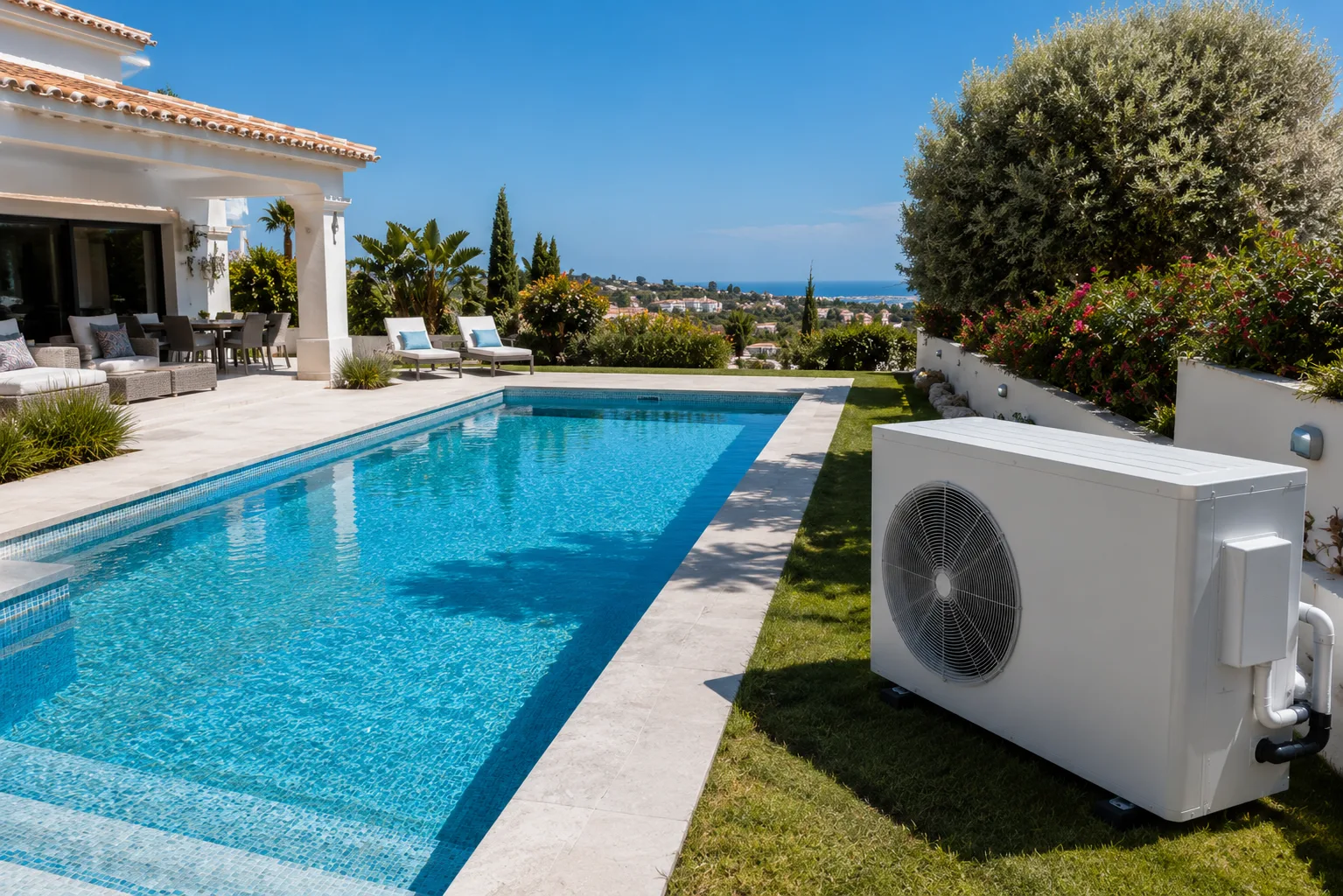
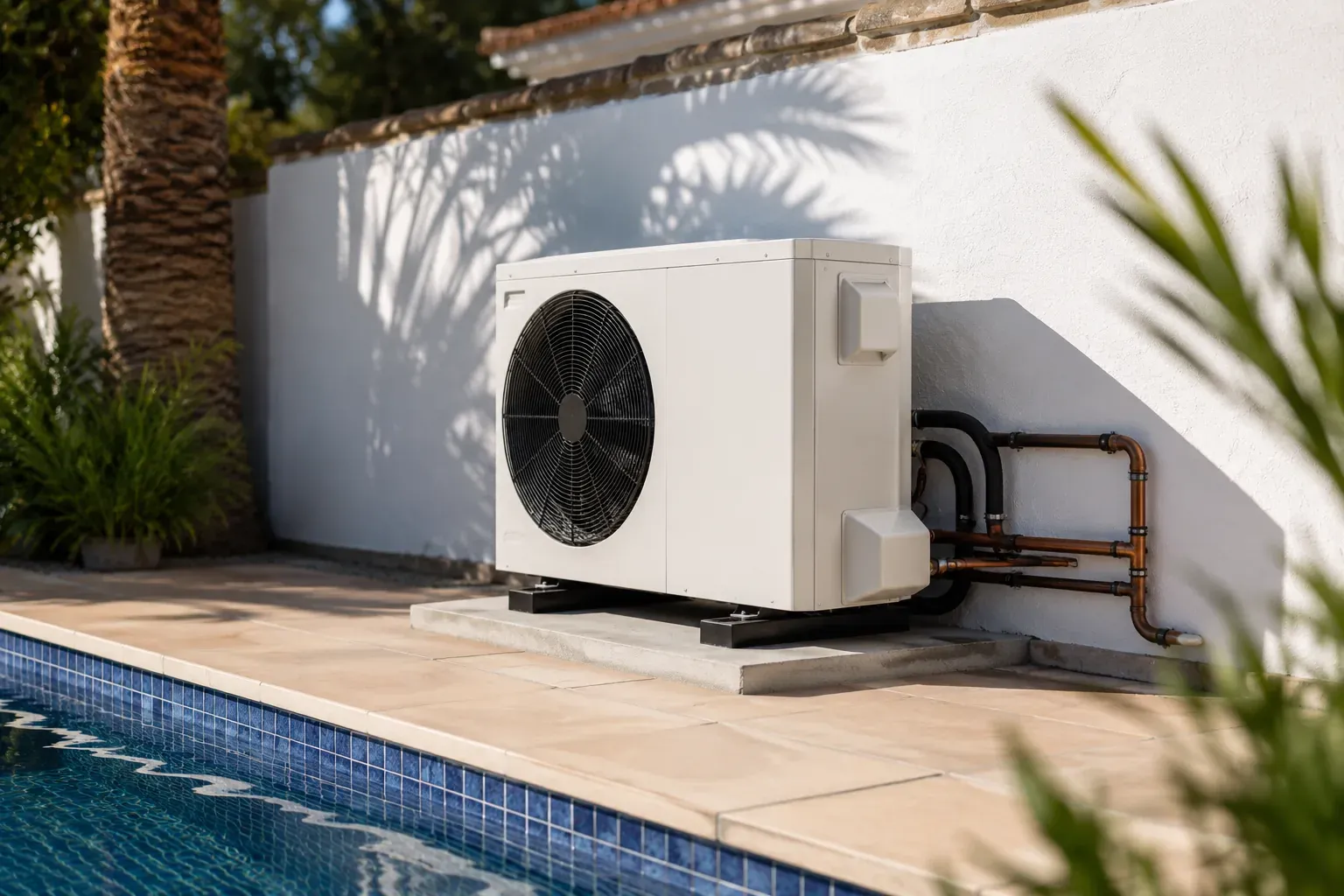
Pool heat pumps installed and serviced for villas, rentals and community pools across the Costa del Sol. F-Gas registered, three-year parts and labour warranty.
Pool heat pumpsSeasonal extensionAquatermic and Astra PoolThree-year warranty
An unheated pool on the Costa del Sol is usable from late June to early September. A pool heat pump extends that by three to four months at each end, so the pool is comfortable from April through to November. For owner-occupiers it means more months of actual swimming. For rental owners it means a real selling point in shoulder season when guests pay full rate but expect a usable pool. We specify, install and service pool heat pumps for villas, townhouses and community pools across the Costa del Sol from Nerja to Gibraltar. Heat pumps and solar collectors are the only legal and economical options for pool heating in Spain.
How a pool heat pump works
A pool heat pump pulls warmth out of the surrounding air and transfers it into the pool water. It does not generate heat the way an electric immersion does, which is why running costs work out at roughly a quarter of a direct electric heater. The cycle inside the unit runs in seven stages.
A fan draws outside air across an evaporator coil
Liquid refrigerant inside the coil absorbs heat from the air and becomes a low-pressure gas
The warm gas passes into a compressor
The compressor squeezes the gas, which raises its temperature sharply
The hot gas travels through a condenser
The condenser transfers heat from the gas into the pool water flowing past it
The refrigerant cools back to liquid and the cycle starts again
Months of swimming you actually gain
A typical Costa del Sol pool sits at 17 to 19 degrees in April and at 22 to 24 degrees by mid-May without help. Most owners want 27 to 28 degrees to swim comfortably. A correctly sized heat pump holds the pool at target temperature from early April through to late November, given a pool cover at night to retain heat. Without a cover the heat pump still works but consumes more electricity. With a cover, running costs through April, May, October and November are modest, and the unit barely runs at all between mid-June and mid-September because the sun is doing the work for free.
Sizing the heat pump to the pool
Sizing depends on water volume, target temperature, exposure to wind and whether a cover is used. A small private pool of 30 to 40 cubic metres usually needs a heat pump rated at 9 to 12 kW. A standard villa pool of 50 to 70 cubic metres needs 13 to 18 kW. A larger pool of 80 to 100 cubic metres or a small community pool needs 20 kW or more, sometimes split across two units. Undersized units run flat out and never reach target temperature. Oversized units cycle on and off and waste capacity. We size every install on water volume measured directly, prevailing wind exposure on the plot and whether the owner uses a cover.
Regulatory position in Spain
Electric heat pumps and solar collectors are the only legal and practical options for heating a private swimming pool in Spain. Gas-fired pool heaters are restricted by RITE and ITC-BT regulations and rarely make sense on running cost grounds for a private pool. Heat pumps use refrigerant gas, so any installer carrying out the work must hold current F-Gas certification. The electrical supply needs a properly rated circuit and an RCD on the consumer unit, certified with a boletin from a registered electrician. Our engineers are F-Gas registered, and a registered electrician is on call for circuit work.
What an EnviroCare pool-heater install includes
A standard install covers removal of any old unit, the new heat pump, a level concrete base or anti-vibration pad, the pipework tee into the existing pool circulation, isolation valves either side of the unit, the condensate drain run, the electrical circuit and RCD, full commissioning and a handover walk-through. We hold stock of the most-installed sizes from Aquatermic and Astra Pool. Owners with an existing pool cover get a flow-rate check on the circulation pump to make sure it matches the new unit. We tidy up and remove the old equipment on the day. Paperwork goes on file for warranty and for any future buyer of the property.
Warranty and aftercare
Every new pool heat pump install carries a three-year EnviroCare parts and labour warranty on top of the manufacturer warranty on the unit, which runs from two to five years depending on brand. Owners on a maintenance contract get an annual pre-season service that covers an evaporator coil clean, refrigerant pressure check, electrical inspection and a full system test before the heating season begins. Installation records stay on file so spare parts can be sourced quickly if the unit needs attention later in its working life.
Survey, quote and installation
From first call to working system
Step 1
Site survey
An engineer visits the property to measure water volume, check the existing circulation pump, confirm a sensible install location with weather and noise in mind and identify the route for pipework and cabling. Survey appointments are free across the Costa del Sol.
Step 2
Sizing and quote
We send a written quote with the recommended kW rating, model, all materials, certifications and the labour figure. Sizing rationale is set out in plain language so the figures can be sense-checked against another quote. No deposit is taken until you accept it.
Step 3
Installation
Most heat pump installs complete in a single day on a like-for-like swap. A new circuit, pipework run or concrete base extends the work to two days. We protect terraces and finishes and remove the old equipment on the day.
Step 4
Commissioning
We commission the unit, set flow rate through the condenser, check refrigerant pressures, programme the controller for the season and walk through day-to-day operation.
Step 5
Three-year warranty
Three-year parts and labour warranty starts the day the unit is signed off. Service history goes on file so any future callout starts with the full record of the install.
Why EnviroCare
Why local experience matters
Trading since 1996
Close to thirty years on the Costa del Sol installing and servicing pool heating for British and European homeowners across the coast from Nerja to Gibraltar.
F-Gas registered engineers
Our installers hold current F-Gas certification, which is a legal requirement for any work on the refrigerant loop of a pool heat pump.
Multilingual team
English, Spanish and Dutch across the office and field staff. Quotes, invoices and warranty paperwork are issued in your preferred language.
Three-year parts and labour
Every new install carries a three-year EnviroCare warranty on parts and labour, on top of the manufacturer warranty on the heat pump itself.
Brands we install
Brands matched to the job
Aquatermic
Spanish-built pool heat pumps with a strong following on the coast. Aquatermic units cover the full range from small private pools at 9 kW up to community pools at 30 kW and beyond. Parts and engineer support are easy to come by anywhere on the Costa del Sol.
Astra Pool
Astra Pool sits at the top end of the residential range. The build quality is a clear step up, the units are quieter, and the controllers handle scheduling and pool-cover detection more elegantly than the budget end of the market. Picked when running cost over a fifteen-year working life matters more than initial outlay.
A heat pump turns a summer-only pool into a system you can use from April through to November. For owner-occupiers it adds three to four months of swimming each year. For rental owners it lets you charge full rate in shoulder season because the pool is genuinely usable. Running costs work out at roughly a quarter of a direct electric heater because the unit pulls heat out of the air rather than generating it from electricity.
How does a pool heat pump work?
A fan draws outside air across an evaporator coil. Liquid refrigerant inside the coil absorbs heat from the air and turns to a low-pressure gas. A compressor squeezes that gas, which raises its temperature sharply. The hot gas passes through a condenser, transferring its heat into the pool water flowing past it. The refrigerant cools back to liquid and the cycle repeats. The unit only uses enough electricity to run the fan and compressor; the bulk of the heat comes from the air.
What size pool heater do I need for a Costa del Sol villa?
Sizing depends on the water volume of the pool, the target temperature, exposure to wind and whether a cover is used. As a rule of thumb, a 30 to 40 cubic metre private pool needs 9 to 12 kW. A 50 to 70 cubic metre villa pool needs 13 to 18 kW. An 80 to 100 cubic metre pool or a small community pool needs 20 kW or more. We size every install on the actual pool volume rather than headline square metre figures.
How much does it cost to run a pool heater on the Costa del Sol?
Costs depend on pool volume, target temperature, whether a cover is used and the months the unit runs. With a cover in place at night, an owner running the heater through April, May, October and November on a typical villa pool can expect electricity costs in the low hundreds of euros per month, depending on tariff. Between June and September the unit barely runs.
Can a pool heater pay for itself on a rental property?
On a rental that is let through April, May, October and November, yes. Guests in shoulder season pay full summer rates only when the listing promises a usable pool. A heat pump turns a six-week summer pool into a seven-month asset, which usually clears the cost of the install across a single shoulder season of additional bookings. The other gain is fewer one-star reviews mentioning a cold pool.
Do I need a pool cover with a heat pump?
A cover is not strictly required, but the running cost of a heat pump roughly halves with one. A pool loses most of its heat overnight through evaporation off the surface. A cover stops that, so the pump only has to top the temperature back up in the morning rather than reheating from a cold start. We recommend a cover for any owner running the heat pump in April, May, October or November.
Are gas pool heaters legal in Spain?
Gas-fired pool heaters are heavily restricted in Spain by RITE and ITC-BT rules and rarely make economic sense for a private pool. Electric heat pumps and solar collectors are the only legal and practical options. If a property has an older gas pool heater fitted by a previous owner, we replace it with a heat pump as part of the install.
Which pool heat pump brands does EnviroCare install?
We fit Aquatermic and Astra Pool. Aquatermic is a practical choice for many private pools because parts support is strong and pricing is sensible. Astra Pool is usually specified when lower noise levels and controller features matter more. Both come with our three-year parts and labour warranty on top of the manufacturer warranty.
Need help with pool heating?
Tell us what you need, where the property is and whether the work is urgent.