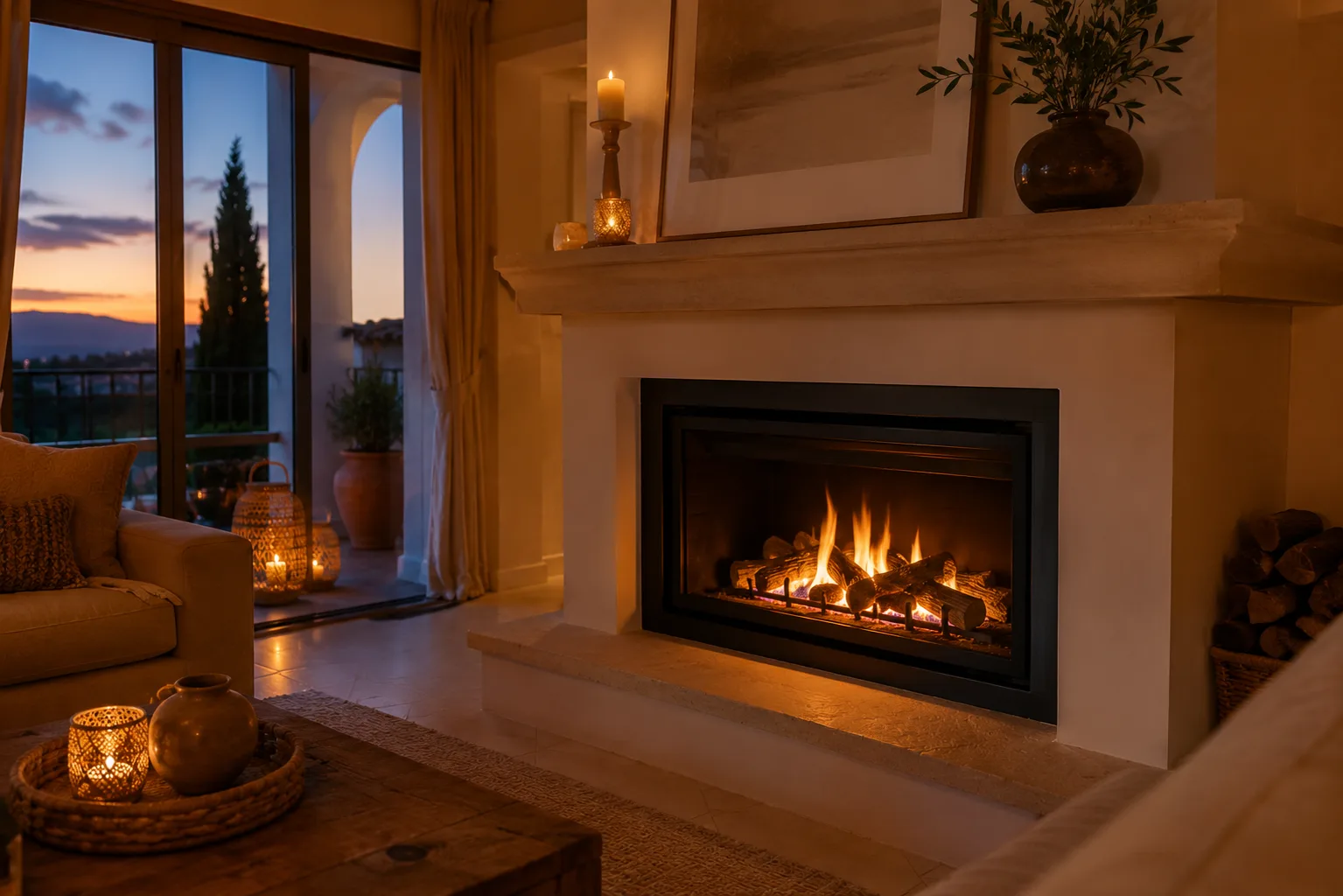
Costa del Sol homes are designed for summer first. Tile floors, single-skin walls and big shaded windows keep things cool through July, then turn cold and damp from late November when the sun drops behind the mountains by half four. A gas fire is the most efficient way to add focused warmth to the room you actually sit in, without firing up whole-home heating for one cold evening. We supply and install insert gas fires, glass-fronted fires, gas stoves, flueless gas radiators, room dividers and feature fireplaces across the Costa del Sol from Nerja to Gibraltar, with the gas certificate paperwork done on the day.
Types of gas fires we install
Eight broad styles cover almost every Spanish home. Insert gas fires drop into an existing fireplace opening and give a tidy, glass-fronted look. Gas stoves stand free and suit rooms without a chimney breast. Flueless gas radiators run without a flue and warm smaller rooms efficiently. Room dividers and tunnel fires work as a feature in open-plan spaces with sightlines from two sides. Corner fires fit awkward room layouts. Classic gas baskets and open-hearth burners drop into traditional fireplaces and keep the period look. Glass-fronted models seal the combustion chamber and run cleaner with higher efficiency than open-fronted fires.
Insert: existing fireplace, tidy glass front
Gas stove: free-standing, no chimney needed
Flueless gas radiator: no flue, smaller rooms
Room divider and tunnel: open-plan feature
Corner: awkward room layouts
Classic basket and open hearth: period fireplaces
Models and ranges we can source
The 2021 catalogue spanned over forty named fire models across eight style categories. Most current installs work from a refreshed list once we know the room, the gas supply and the style of finish. Insert and stove model names below are kept from the legacy catalogue so owners searching by model name can still find the relevant gas fire information. Spec tables for corner fires, 3-sided fires, glass-fronted fires, room dividers, tunnels, special fires, gas radiators and classic gas baskets sat on standalone WordPress pages that we redirected during the Astro rebuild; the spec tables can be brought back into a single comparison block on this page if Helen wants them surfaced.
Glass-fronted, corner, 3-sided, room divider, tunnel and special fires: spec tables available on request
Classic gas baskets (Spanish 18", Spanish 21", Bristol) and classic fireplaces (Tregaron, Galway, Bolton, Makintosh)
Gas burners and open-hearth fires in standard 50/70 cm and tray formats 45 cm to 135 cm
Butane, propane or piped natural gas
Three fuel options run a gas fire in Spain. Butane bottles (the orange ones) are the default for most Costa del Sol properties, sit in a vented cupboard and need swapping when empty. Propane works the same way, often supplied from a buried tank for villas with higher demand, and burns hotter than butane in cold weather. Piped natural gas reaches a small share of properties, mostly newer urbanisations in Mijas Costa, parts of Marbella and central Fuengirola, and removes the bottle-changing job entirely. Most fires we install are configured for butane or propane out of the box, with a conversion kit available where natural gas is on tap.
Spanish gas regulations and the boletin
Spain regulates gas appliances under RITE (Reglamento de Instalaciones Termicas en los Edificios) and supplementary gas-installation rules. Any new gas fire install needs a registered gas installer to fit the appliance, verify the pipework and issue a boletin de gas (gas certificate). The boletin is the legal document that proves the install meets current rules and the property owner needs it for home insurance, resale and any future appliance change. Bottle-fed butane and propane installations also need a periodic inspection, every five years on most domestic setups. We issue the boletin the day the work is signed off.
What an EnviroCare gas-fire install includes
A standard install covers the survey, supply and fit of the fire, gas pipework from the bottle cupboard or mains tap to the appliance, flue work where the model needs one, hearth or surround if specified, commissioning and the boletin. We test for gas tightness, check the flue draws clean, run the burner through its full output range and walk through the controls and shutdown procedure. Old appliances are removed on the day. For homes upgrading from an open wood-burning fireplace to a gas insert or basket, we cap and clean the chimney, fit the gas line and seal the surround so the new fire runs efficiently.
Warranty and aftercare
Every new gas-fire install carries a three-year EnviroCare parts and labour warranty on top of the manufacturer warranty on the appliance, which typically runs from two to five years depending on model. Annual servicing keeps the burner clean, the flue clear and the gas connection within the periodic inspection window. Owners on a maintenance contract get the service booked in automatically and a priority callout slot when the first cold snap hits and the appliance has not been used since spring. Installation records stay on file so spare parts can be sourced fast when something does need attention later.
Survey, quote and installation
From first call to working system
Step 1
Site survey
An engineer visits the property to check the room, existing chimney or flue route, ventilation, and where the gas supply will come from. Survey appointments are free across the Costa del Sol.
Step 2
Gas type and flue check
We confirm whether the install runs on butane, propane or piped natural gas, and whether the chosen fire needs a flue, a flueless installation or an insert into an existing chimney.
Step 3
Fire selection and quote
We send a written quote with the recommended fire, sizing rationale, all materials and gas certifications, plus the labour figure. No deposit is taken until you accept it.
Step 4
Registered gas installation
A registered gas installer fits the appliance, runs the pipework and tests for tightness. Most installs complete within one day.
Step 5
Commissioning and boletin
We commission the fire, run a full output test, walk through the controls and issue the boletin de gas. Three-year parts and labour warranty starts that day.
Why EnviroCare
Why local experience matters
Trading since 1996
Close to thirty years on the Costa del Sol installing winter heating for British and European homeowners across the coast from Nerja to Gibraltar.
Registered gas installer
Our installers fit and certify gas appliances under Spanish RITE rules, and the boletin de gas is issued the day the work is signed off.
Multilingual team
English, Spanish and Dutch across the office and field staff. Quotes, invoices and warranty paperwork are issued in your preferred language.
Three-year parts and labour
Every new install carries a three-year EnviroCare warranty on parts and labour, on top of the manufacturer warranty on the appliance itself.
A gas stove is a free-standing gas fire built to look like a traditional wood-burning stove, with a sealed glass front and a flue. It draws cool air at floor level, heats it through the burner chamber and pushes warm air back into the room. Domestic models typically rate between 5 and 9 kW, enough to warm a 25 to 40 square metre living room on the coldest evenings.
What types of gas fires can I install in a Spanish home?
Insert gas fires, gas stoves, glass-fronted fires, flueless gas radiators, corner fires, room dividers and tunnel fires, and classic gas baskets in open-hearth fireplaces. Choice depends on whether the room has an existing chimney, how much wall or floor space is available, and how the fire is meant to look in the room.
Are gas fires allowed in Spain?
Yes. Gas fires are legal across Spain when fitted by a registered gas installer and certified with a boletin de gas. The boletin is the legal document required for home insurance and resale. Bottle-fed butane and propane installations also need a periodic inspection on a five-year cycle for most domestic setups.
What is the most efficient winter heating for a Costa del Sol home?
For a single living room used in the evenings, a gas fire is usually the most efficient option. It heats the space you actually use without firing up whole-home central heating. For larger villas with multiple cold rooms, ducted air-conditioning in heat-pump mode or piped natural gas central heating make more sense.
Do I need natural gas piped to the property?
No. Most Costa del Sol homes run gas fires on bottled butane or propane from a vented cupboard or a buried propane tank. Piped natural gas reaches a small share of properties, mostly newer urbanisations. Most fires we install run on butane or propane out of the box, with a conversion kit available where natural gas is on tap.
Can I run a gas fire on bottled gas?
Yes. Butane bottles (the standard orange ones) and propane bottles are the default fuel for most gas fires on the Costa del Sol. The bottle sits in a vented cupboard or external store and feeds the fire through certified gas hose and rigid pipework.
Is a flueless gas fire safe?
Flueless gas fires are safe when fitted to a properly ventilated room with the right air change rate. They include oxygen-depletion sensors that shut the fire down if the room runs short of oxygen. They suit smaller rooms and are not recommended for bedrooms or bathrooms.
Glass-fronted gas fire or insert: which is better?
Glass-fronted models seal the combustion chamber, run cleaner and burn more efficiently than open-fronted fires. An insert gas fire is itself a glass-fronted unit designed to drop into an existing fireplace opening. Choose an insert if you already have a fireplace and want a tidy upgrade. Choose a free-standing glass-fronted stove if there is no fireplace and you want focused warmth in the centre of the room.
Need help with gas fires?
Tell us what you need, where the property is and whether the work is urgent.